
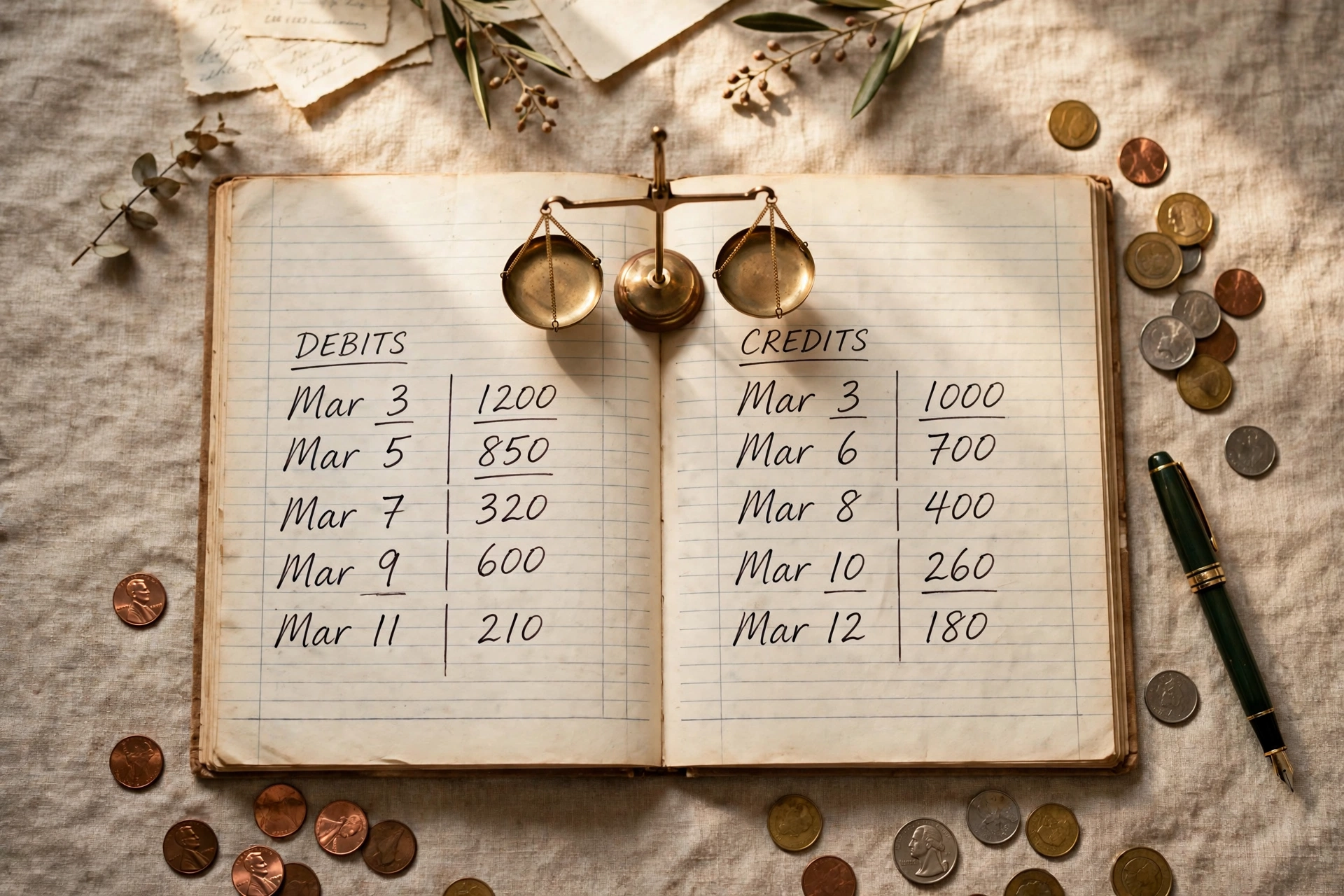
The short answer: double-entry bookkeeping is a recording system where every transaction is written down twice — once for what you got, and once for what you gave up in exchange. That second entry is not extra paperwork. It is the reason your balance sheet balances, the reason errors surface instead of hiding, and the reason every accounting program, from a paper ledger to modern cloud software, works the same way underneath.
This article is research-based analysis of how the system works, last researched in October 2026. It explains the mechanism first, then the jargon, so you can follow what your software is doing even if you never post a journal entry by hand.
Start with the swap, not the vocabulary
Forget debits and credits for a moment. Think about what actually happens in any business transaction:
- You pay rent. You lose cash, but you gained a month of occupancy. Two things changed.
- A client pays an invoice. You gain cash, but you lose the right to chase them for that money — the IOU is gone. Two things changed.
- You take out a loan. You gain cash today, but you gain a debt in the same instant. Two things changed.
Nothing in a business changes on only one side. Value always comes from somewhere and goes somewhere. Single-entry bookkeeping — a checkbook register, a simple list of money in and money out — records only one side. It can tell you your cash balance. It cannot tell you, from the same records, what you own, what you owe, and whether you actually made a profit, because it never tracked the other side of each swap.
Double-entry records both sides, every time. That is the entire idea. The rest is notation.
The one equation behind everything
Every double-entry system is built to keep one relationship true at all times:
Assets = Liabilities + Equity
In plain terms:
- Assets — what the business owns or controls that has value: cash, equipment, inventory, and money customers owe you.
- Liabilities — what the business owes to outsiders: loans, supplier bills, credit card balances, taxes payable.
- Equity — the owners’ claim: what you put in, plus profits the business has kept, minus what you have taken out.
Read the equation as a sentence: everything the business owns was paid for either by borrowing from outsiders (liabilities) or by the owners’ stake (equity). There is no third source. If assets go up, either liabilities or equity must go up by the same amount. If assets go down, one of those must go down, or another asset must go up to take its place.
That is why every transaction hits two accounts. A one-sided entry would break the equation, and the system is designed so a broken equation is visible immediately. The two entries are the mechanism that keeps the claim, “we can explain where every dollar came from and where it went,” checkable at any moment.
For day-to-day work, accountants expand equity into its moving parts:
Assets = Liabilities + Owner contributions + Revenue − Expenses − Owner draws
Revenue increases equity because profitable work makes the owners’ claim bigger. Expenses decrease it. This is why your profit and loss statement and your balance sheet are not separate reports that happen to share numbers — they are two views of the same equation.
Worked examples a non-accountant can follow
Meet a fictional one-person design studio starting from zero. Watch the equation after each step. (Amounts are illustrative examples, not prices researched for October 2026.)
| Step | What happened | Assets | = Liabilities | + Equity |
|---|---|---|---|---|
| Start | Nothing yet | $0 | $0 | $0 |
| 1 | Owner puts in $5,000 of personal savings | $5,000 cash | $0 | $5,000 |
| 2 | Buys a laptop for $1,200 cash | $5,000 ($3,800 cash + $1,200 equipment) | $0 | $5,000 |
| 3 | Invoices a client $800, not yet paid | $5,800 (adds an $800 IOU) | $0 | $5,800 |
| 4 | Client pays the $800 | $5,800 ($4,600 cash + $1,200 equipment) | $0 | $5,800 |
| 5 | Pays $900 rent | $4,900 | $0 | $4,900 |
| 6 | Buys $400 of supplies on supplier credit | $5,300 | $400 | $4,900 |
A few steps deserve a closer look:
Step 1 — putting your own money in is not income. Cash (assets) rose by $5,000, so equity had to rise by $5,000 to balance. The business did not earn anything; the owners’ claim just got bigger. This is why recording an owner contribution as “sales” overstates revenue — the equation forces you to ask, “did this cash come from a customer, a lender, or me?”
Step 2 — spending is not always an expense. The laptop swapped one asset (cash) for another asset (equipment). Total assets and equity did not move. If you recorded the purchase as a pure loss, you would understate what the business owns. The cost becomes an expense gradually, through depreciation, as the laptop is used up — a topic your accountant handles, but the two-sided entry is what makes it possible.
Step 3 — a sale happens when you earn it, not only when cash arrives. Invoicing created a new asset, accounts receivable (the client’s IOU), and increased equity through revenue. Notice step 4 then changes nothing in total: the IOU asset converts into the cash asset. If you only tracked cash, steps 3 and 4 would look like the entire sale happened at payment, and your monthly profit would jump between months for no economic reason. This timing difference is the heart of the cash versus accrual choice — see our guide to accounting software explained for how software handles both views.
Step 6 — buying on credit creates an asset and a debt at once. Supplies rose by $400, and so did accounts payable. When the studio later pays that bill, cash and the liability will both fall by $400, and equity will not move — paying a bill is not a new expense, because the expense was already counted when the supplies were received.
Bold takeaway: if you can say, for any transaction, “what did we get, and what did we give or owe in return,” you already understand double-entry. The rest is filing.
Debits and credits: the notation, after the idea
Bookkeepers needed a way to write both sides without redrawing the equation each time. The solution, codified by Franciscan friar Luca Pacioli in his 1494 Summa de Arithmetica — he described the Venetian merchants’ method, he did not invent it — is the T-account: each account has a left side (debit) and a right side (credit).
The rule that replaces memorization:
| Account type | Debit does this | Credit does this |
|---|---|---|
| Assets | Increase | Decrease |
| Expenses | Increase | Decrease |
| Liabilities | Decrease | Increase |
| Equity | Decrease | Increase |
| Revenue | Decrease | Increase |
Why this split? Assets sit on the left of the accounting equation, so increases are recorded on the left (debit). Liabilities and equity sit on the right of the equation, so increases are recorded on the right (credit). Expenses reduce equity, so they behave like the left side; revenue increases equity, so it behaves like the right side. The table is the equation, rotated into a filing rule — it is not five separate facts to memorize.
For the laptop purchase, the journal entry is:
- Debit Equipment $1,200 (asset up)
- Credit Cash $1,200 (asset down)
Total debits equal total credits: $1,200 = $1,200. Pacioli’s reported advice was that a bookkeeper should not sleep until the debits equalled the credits. Today, that check is the trial balance: list every account’s balance, add the debits, add the credits, and confirm the totals match. A mismatch does not tell you which entry is wrong, but it proves one is — which is more than a checkbook register can ever do. A matched trial balance is not proof that everything is categorized correctly, only that the arithmetic is internally consistent.
Why your software hides all of this from you
Modern accounting software is, at its core, a double-entry engine with friendly forms on top. You never see a T-account because the form does the translation:
- Send an invoice → the software debits Accounts Receivable and credits Sales Revenue.
- Record a bill → it debits an expense or asset account and credits Accounts Payable.
- Categorize a bank fee → it debits Bank Fees and credits Cash.
- Run payroll → it splits one payment into wage expense, tax liabilities, and cash, often five or more entries at once.
This hiding is mostly a good trade. It prevents the most common beginner error — unbalanced or half-recorded entries — and lets you work in business language (“send invoice,” “pay bill”) instead of accounting language. Bank feeds extend the same deal: the software proposes the other side of each bank transaction, and you confirm it.
The cost of the hiding is that when the software guesses wrong, the error is invisible in the form but very visible in the reports. Common examples:
- A loan payment categorized entirely as an expense, when part of it repays principal (a liability) and only the interest is an expense. Profit looks worse than it is, and the loan balance never falls.
- Owner draws recorded as wages or expenses, which distorts both profit and what you actually paid yourself.
- A refund recorded as negative revenue in the wrong period, or as an expense, which makes two different reports wrong in two different ways.
- Duplicate revenue: the invoice is recorded, and then the bank deposit is recorded as a second sale instead of as payment of the first.
Each of these is a broken swap: one side of the transaction was filed in the wrong account. You do not need to post journal entries to catch them. You need to know the swap should exist, then look for it.
When to peek under the hood
You do not need to audit your books daily. Peek in these situations:
- A report surprises you. Profit looks strong but cash is tight, or a balance sheet account (like Accounts Receivable) is larger than the invoices you believe are unpaid. Open the account detail and read the individual entries — you are looking for the missing or duplicated other side.
- A balance will not reconcile. Reconciliation is the modern, bank-level version of Pacioli’s trial balance: your records against the bank’s records. A persistent difference is almost always a one-sided or duplicated entry.
- You record something unusual. Buying equipment, taking a loan, taking money out of the business, or receiving a large prepayment for future work. These are precisely the transactions where the intuitive single entry (“money out = expense,” “money in = income”) is wrong, and where a quick look at the resulting journal entry pays off.
- Before you hand books to an accountant or lender. Run the balance sheet and ask of every line: “can I explain what makes this number up?” If a liability has a strange negative balance, or equity does not move the way profit suggests it should, flag it rather than hoping no one notices.
Most programs expose this under names like Journal Report, Account Transactions, or Audit Log. You are not looking to become the bookkeeper — you are checking that both sides of each important swap landed where you intended.
Double-entry versus single-entry, at a glance
| Question | Single-entry (checkbook style) | Double-entry |
|---|---|---|
| What is recorded? | Mainly cash in and cash out | Both sides of every transaction |
| Can it produce a balance sheet? | No — assets and debts outside cash are untracked | Yes, directly from the same records |
| Built-in error check? | None; a missed entry looks identical to a correct book | Trial balance: debits must equal credits |
| Profit calculation | Cash left over, which mixes timing with performance | Revenue minus expenses, separable from cash timing |
| Who needs it? | Very small, cash-only activity with no inventory, credit, or borrowing | Any business that invoices, borrows, holds inventory, or wants lender-ready reports |
Single-entry is not dishonest; it is incomplete. It answers “how much cash do we have” honestly while remaining silent on “what do we own, owe, and truly earn.” Double-entry exists because merchants in Renaissance Venice needed all four answers from one set of books — and five centuries later, in October 2026, your software is still keeping Pacioli’s side of that bargain for you.
Bottom line: double-entry bookkeeping is not a ritual of debits and credits. It is the discipline of recording both sides of every swap so the equation Assets = Liabilities + Equity never stops being true — and so, when it appears to break, you know to go looking for the mistake instead of trusting a number that was never checked.