
The short answer: match the tool to how you bill. HubSpot free ($0, up to 2 users, 1,000 contacts) is where most freelancers should start — a genuine pipeline, email tracking, and meeting scheduling for nothing. Moxie Starter ($10/month billed annually) is the best all-in-one for freelancers who bill by the hour or the project: CRM plus time tracking, contracts, proposals, and invoicing in one subscription. Pipedrive Lite ($14/user/month billed annually) is the best pure pipeline for retainer and deal-chasing freelancers. Less Annoying CRM ($15/user/month, one flat plan) is the simplest — about twenty minutes from signup to a working pipeline. Capsule (free for 2 users / 250 contacts; Starter $18/user/month annually) is the cleanest contact-first CRM. Bigin Express ($7/user/month billed annually) is the cheapest paid pipeline. And for service sellers whose pain is the proposal-to-payment admin arc, HoneyBook Starter ($29/month billed annually) is the polished pick and Dubsado Starter ($35/month, or $335/year) is the customizable one.
Affiliate disclosure. We don’t have affiliate partnerships with any vendor yet, so every link below is a plain link to the vendor’s own site — nobody pays us for clicks or signups, and that won’t change what we recommend. If we add affiliate programs later, this article will say so.
The freelancer equation: the juggle, the billing model, and unbilled admin
A freelancer’s CRM problem is different from a small team’s, and different again from a solopreneur running a productized service. Three things shape it.
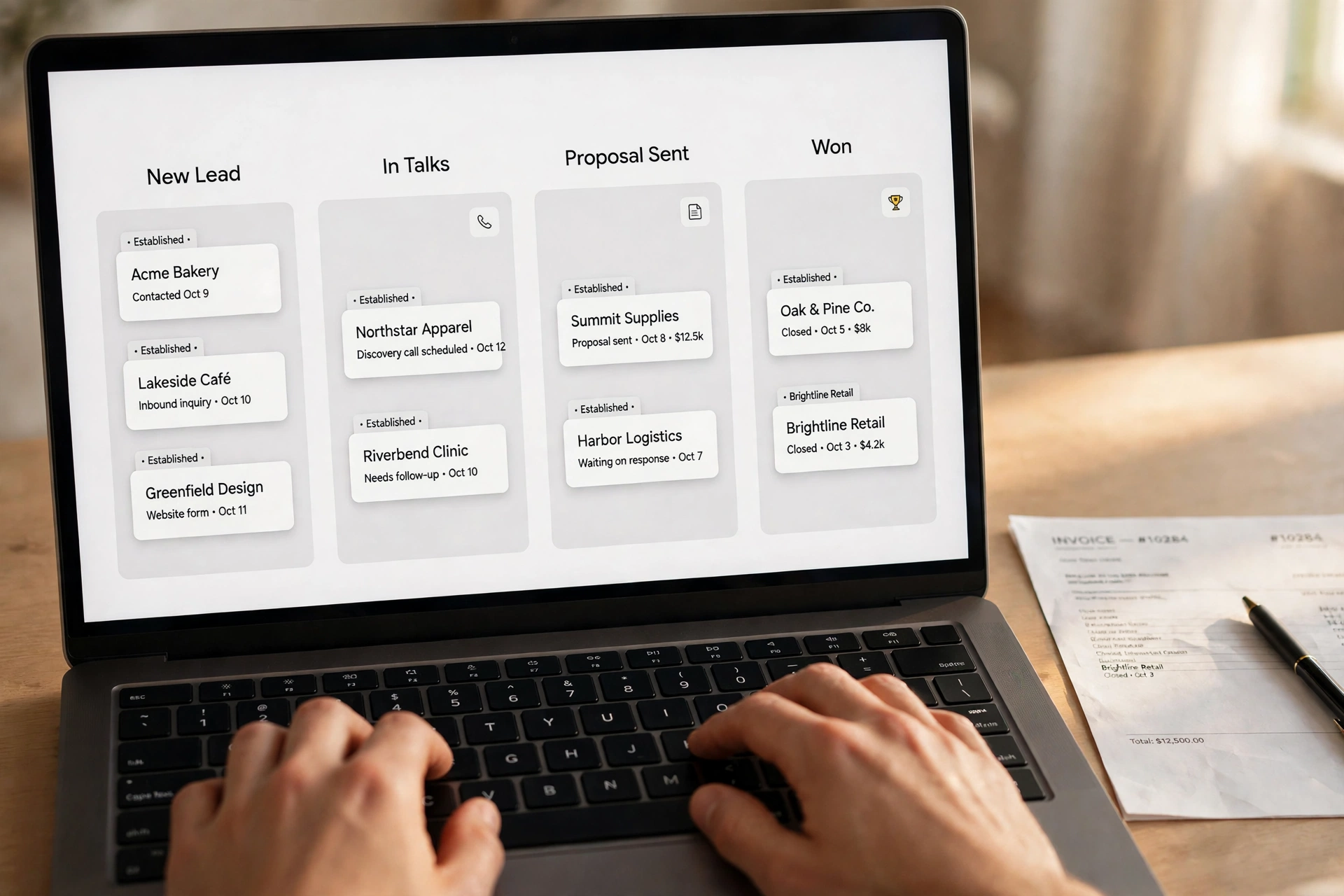
First, you are juggling five to fifteen clients at once, in different stages. One is a warm lead, two are waiting on proposals, three are mid-project, one owes you an invoice, and one hasn’t replied in three weeks. A spreadsheet holds the names; it does not tell you who needs a nudge today. The CRM’s job for a freelancer is triage — surfacing the next action across a dozen concurrent relationships — and a tool that only stores contacts without staging them by next step misses the point.
Second, how you bill decides which tool fits. Hourly and project freelancers need time tracking tied to the client record, because unbilled hours are lost revenue. Retainer freelancers need pipeline discipline and renewal reminders. Creative service sellers (designers, photographers, coaches) need proposals, contracts, and payment collection in one flow, because the admin arc — not the pipeline — is where their hours leak. A pipeline-only CRM is the wrong purchase for a designer drowning in proposals, and a proposal system is the wrong purchase for a consultant chasing retainers.
Third, admin time is unbilled time. Every minute spent logging data is a minute not billed to a client, which is why simplicity is the load-bearing feature for freelancers, not a nice-to-have. A tool you abandon after two weeks because data entry takes too long is a worse purchase than a simpler tool you actually use — a CRM with stale data costs money to mislead you. And because freelance income is irregular, flat predictable pricing beats per-seat pricing that jumps when you add a VA or a subcontractor.
So pick by the work, not the feature list:
- Bill by the hour or the project — you need time tracking attached to the client. You want Moxie.
- Chase retainers and repeated deals — you need pipeline discipline. You want Pipedrive, Bigin, or Less Annoying CRM.
- Sell creative services, drown in proposals and contracts — you need the client workflow. You want HoneyBook or Dubsado.
- Sell through relationships and referrals — you need a smart contact book with reminders. You want Capsule.
- Budget is zero and you need to start today — you want HubSpot free.
The free tiers, and when free stops being enough
Start free — four tools here let you run indefinitely at $0, and the follow-up habit matters more than the tool. But free caps are the designed end of the runway, so know where yours runs out and what the first paid step costs.
| Free plan | Caps | First paid step |
|---|---|---|
| HubSpot | 2 users, 1,000 marketing contacts, 1 pipeline, 1 automated action | Sales Starter: $20/seat/month |
| Capsule | 2 users, 250 contacts, 1 pipeline | Starter: $18/user/month (annual) |
| Bigin | 1 user, 500 records, 1 pipeline, 3 automations | Express: $7/user/month (annual) |
| Zoho CRM | 3 users, 5,000 records | Standard: $14/user/month (annual) |
When free stops being enough: the contact caps end the free run first for anyone with a real list — importing five years of contacts can push you off Capsule’s 250-contact cap or Bigin’s 500-record cap on day one, while Zoho’s 5,000 records and HubSpot’s 1,000 contacts hold longer. The automation gates end it second: HubSpot free allows one automated action and no sequences, Bigin free allows 3 automations, and real follow-up automation — the thing most freelancers actually buy a CRM for — starts at Bigin Express ($7), Pipedrive Growth ($39), or Capsule Growth ($36). The seat caps end it third: HubSpot free stops at 2 users, so the day you add a VA or a subcontractor who needs a login, you are paying. If follow-up automation is why you want a CRM, skip straight to the cheapest tier that has it — the free tier was never going to hold you.
Two tools here have no free plan at all: Moxie (14-day trial, then $10/month annual) and Pipedrive (14-day trial, then $14/month annual), and HoneyBook and Dubsado are trial-only too. That is a filter in your favor — you are paying for a tool whose whole design centers on the job, not a free tier engineered to convert you. Our free CRM guide maps the free ladder in full, and our cheapest CRM roundup covers the budget math across vendors.
The options, side by side
| CRM | Starting price | Free tier | Time tracking | Invoicing | Best for |
|---|---|---|---|---|---|
| HubSpot | $0 → Starter $20/seat | Yes (2 users, 1,000 contacts) | No | No | Starting from zero budget |
| Moxie | Starter $10/mo (annual) | Trial only | Yes | Yes | Hourly/project freelancers, all-in-one |
| Bigin by Zoho | $0 → Express $7/user/mo (annual) | Yes (1 user, 500 records) | No | Payment links | Cheapest real pipeline |
| Pipedrive | Lite $14/user/mo (annual) | Trial only | No | No | Retainer and pipeline sellers |
| Less Annoying CRM | $15/user/mo flat | 30-day trial | No | No | Zero learning curve |
| Capsule | $0 → Starter $18/user/mo (annual) | Yes (2 users, 250 contacts) | No | Via Xero/QuickBooks | Clean contact-first CRM |
| HoneyBook | Starter $29/mo (annual) | Trial only | No | Yes | Creative service sellers |
| Dubsado | Starter $35/mo ($335/yr) | 21-day trial | No | Yes | Customizable client workflows |
Prices researched 2026-11-07 from vendor pricing pages (HoneyBook read live today; HubSpot and Zoho per our November 6 checks) and current third-party pricing reads (Moxie, Dubsado, Pipedrive, Capsule, Less Annoying CRM, Bigin — each figure cross-checked against at least two independent sources). Vendors reprice and re-tier regularly — confirm your exact tier before committing.
The CRMs, product by product
HubSpot — the free start every freelancer should take ($0; Starter $20/seat)
HubSpot is the only free CRM here that feels like a real product rather than a trial: contact management, a deal pipeline, email tracking, and a meeting scheduler for $0, with no expiration. For a freelancer’s first year, that’s genuinely enough — import your contacts, set up the pipeline, connect your inbox, and build the follow-up habit before spending anything.
The design is the funnel, and it’s worth understanding: the caps are engineered to convert you exactly when you grow. The 2-user limit forces a paid seat at your first hire. The single pipeline and single automated action force an upgrade the moment your process gets sophisticated. Starter lists at $20 per seat per month (currently shown at a $7 promotional rate for new customers on annual billing) buys breathing room; real sales automation — sequences, workflows — waits at Professional, $90 per seat per month plus a mandatory one-time $1,500 onboarding fee, which no freelancer should pay. HubSpot has no time tracking and no invoicing, so it is a pure CRM — pair it with a separate invoicing tool once you outgrow the free tier. Best for: starting at $0 with no ceiling on how long you can stay.
Moxie — the freelancer all-in-one: CRM, time tracking, contracts, and invoicing ($10/month annual)
Moxie (formerly Hectic) is the only tool on this list built specifically for freelancers rather than adapted to them: client management and a pipeline, time tracking, project management, proposals with attorney-vetted contract terms, invoicing, expense tracking with bank connections, and a client portal — in one subscription, priced flat rather than per seat. Starter is $12/month, or $10/month billed annually; Pro is $25/month ($20 annual) and adds the white-labeled client portal, workflow automation, and Zapier; Teams is $40/month ($32 annual) for up to 5 members. There is no free plan — a 14-day trial, no credit card required.
The economics are the point: Moxie replaces two or three subscriptions. A freelancer paying separately for a CRM, a time tracker, and an invoicing tool is usually paying more than $10 a month before any of them talks to the others. Moxie also passes payment processing through Stripe and PayPal at their standard rates with no markup — unlike HoneyBook’s 2.9% + 25¢ per card transaction — which matters when a large share of your revenue flows through the tool. The honest limits: the pipeline is basic (no deal values on stages, no probability scoring, no revenue forecasting), time tracking does not auto-populate invoices, and the client portal and automations wait on Pro. Moxie works globally, where HoneyBook is US and Canada only. Best for: hourly and project freelancers who want one subscription covering the whole business, from first contact to paid invoice.
Bigin by Zoho — the cheapest real pipeline ($0; Express $7/user/month annual)
Bigin is Zoho’s answer to everyone who finds Zoho CRM intimidating: a focused, visual pipeline CRM a new user learns in about an hour. The free tier ($0, 1 user, 500 records, 3 automations, built-in phone, booking pages) is a working CRM, not a teaser — and at $7/user/month billed annually ($9 monthly), Express is the cheapest paid pipeline on this list, with 50,000 records, 30 automations, two-way email integration, mass emails with open tracking, and payment links via Stripe and PayPal.
The design philosophy is the point: Bigin deliberately excludes the enterprise depth — no forecasting module, no advanced workflow builder. That restraint is what makes it fast for one person. The trade-off is the ceiling: scaling past a small team means migrating to full Zoho CRM, and the automation and AI features live on Premier ($12) or Bigin 360 ($18). Note the monthly-billed price runs about 30% higher than annual — pay yearly if you’re committed. Best for: freelancers who want a genuine pipeline and email automation at the lowest honest price.
Pipedrive Lite — the pipeline seller’s pick ($14/user/month annual)
Pipedrive is the cleanest visual pipeline in the business, and Lite at $14/user/month billed annually ($24 month-to-month) is priced for exactly one person: lead, deal, and contact management, AI-powered report creation, 500+ integrations, and a meeting-intelligence tool. The 14-day free trial (no credit card) is the honest way to test whether you’ll actually log data in it.
Two honest cautions. First, email automation lives on Growth at $39/month — Lite has email logging and meeting intelligence, but bulk emails and nurture sequences are a paid jump. If automated follow-up is the reason you’re buying, Lite isn’t the plan; Growth is. Second, Pipedrive has no free tier and no invoicing or time tracking — it is a pure sales pipeline, and it is the best one here for freelancers whose work is winning the next retainer rather than managing the current project. Best for: retainer and deal-chasing freelancers who live in their pipeline and want the best stage-by-stage UX.
Less Annoying CRM — the simplest thing that works ($15/user/month flat)
Less Annoying CRM has one price, one tier, no feature gates: $15/user/month gets you everything — unlimited contacts and companies, unlimited pipelines, unlimited custom fields, 25GB storage, task management, email logging, and free human support that answers the phone. The 30-day free trial has no credit card and no limitations, and setup genuinely takes about twenty minutes.
This is the deliberate anti-enterprise play, and it shows in what’s missing: no marketing automation to speak of, a mobile experience that works but won’t delight, and activity logging that’s manual. For a freelancer that’s the trade working as designed — the product’s whole argument is that a CRM you actually use beats a CRM you could theoretically do more with. The flat price also means no per-seat surprises and no upgrade cliffs: $15 today, $15 when you add a VA. Best for: non-technical freelancers who want contacts, pipeline, and follow-up reminders with the least possible learning curve.
Capsule — the clean contact-first CRM ($0; Starter $18/user/month annual)
Capsule is the minimalist’s CRM: a genuinely clean interface, visual pipeline, contact management, and — unusually — two users on the free plan (250 contacts, 1 pipeline). For a freelancer with a VA or a collaborator, that’s two seats at $0, which no other free tier here offers. Starter is $18/user/month billed annually ($21 monthly) with 30,000 contacts, email templates, a shared mailbox, and premium integrations like Xero and QuickBooks.
The ceiling arrives fast: one pipeline and no workflow automation on Starter, and two-way email sync plus automations wait at Growth ($36/user/month annual). If automation and multiple pipelines are why you want a CRM, budget for Growth from the start — Starter’s jump is the steepest on this list. Capsule’s project boards are a genuine bonus for freelancers who deliver work after the sale. Best for: relationship-first freelancers who want the cleanest interface, and freelancer-plus-VA setups that need two free seats.
HoneyBook — the client-workflow all-in-one for creative service sellers (Starter $29/month annual)
HoneyBook isn’t quite a CRM — it’s the client business operating system for service sellers: unlimited clients and projects, proposals, contracts with e-signatures, invoices, card and ACH payments, a client portal, lead forms, and a scheduler. The CRM layer (customizable pipeline, tags, automations) sits inside that workflow. Starter is $29/month billed annually ($36 month-to-month); Essentials at $49/month adds scheduler, automations, SMS reminders, and QuickBooks Online integration — the automations gate is the one that matters; Premium is $109.
The economics to understand: HoneyBook replaces two or three subscriptions. If you’re currently paying for a CRM plus an invoicing tool plus a contract tool, $29 consolidates them. Payment processing is 2.9% + 25¢ per card transaction and 1.5% for ACH — standard, but budget it into your pricing, because it applies to every dollar your clients pay you through the platform. The trade-off is specialization: HoneyBook is built for service businesses (designers, photographers, consultants, coaches), works in the US and Canada only, and fits awkwardly outside that shape; its pipeline CRM is lighter than Pipedrive’s. Best for: creative service freelancers whose real pain is the proposal-to-payment admin arc, not pipeline management.
Dubsado — the customizable client workflow, for power users (Starter $35/month)
Dubsado takes the same client-workflow job as HoneyBook and optimizes for control instead of polish: deeply customizable forms with conditional logic, lead capture, contracts, invoices with payment plans, a client portal, scheduling, and automated workflows — plus multiple brands under one account. Starter is $35/month, or $335/year (about $27.92/month); Premier is $55/month, or $525/year (about $43.75/month). The first three users are included, extra users cost more, and there is no free plan — a 21-day trial with full access to Premier, no credit card.
Two honest cautions. First, the trial shows you the $55 product, so judge your cost against Premier, not Starter — Starter has no scheduler and no automated workflows, and the signature Flows automation only comes on Premier. Second, Dubsado raised prices on December 1, 2025 (Starter from $20 to $35, Premier from $40 to $55), so older comparisons quoting $20 are out of date. Payments run through Stripe or Square. The payoff for the price and the setup time is depth: photographers and coaches running multiple brands or complex onboarding sequences get a system HoneyBook can’t match. Best for: freelancers who want total control over their client workflow and are willing to invest setup time to get it.
Zoho CRM — the free holdout ($0; Standard $14/user/month annual)
Zoho CRM earns its place on the generosity of its free tier alone: 3 users, 5,000 records — the most data any free plan here holds. For a freelancer who loathes subscriptions and has a large existing list, it’s the longest free runway in the market. Standard at $14/user/month billed annually adds real workflow automation, scoring rules, and multiple pipelines.
The catch is complexity: Zoho CRM is the full platform, and it shows — more setup, more menus, more surface area for a one-person business to get lost in. Most freelancers who find Zoho too much should try Bigin first (same company, one-tenth the confusion). But if you want maximum free data with a real automation ladder behind it, Zoho’s free tier is the answer. Best for: data-heavy freelancers who want the most generous free plan and can tolerate the full platform’s learning curve.
The three traps that decide the real bill
1. The automation gate, not the headline price. The cheapest plan is never the cheapest working CRM. Pipedrive Lite is $14 but the email automation you bought it for is on Growth at $39. HubSpot is $0 but sequences are on Professional at $90 plus a $1,500 onboarding fee. Capsule Starter is $18 but automations are on Growth at $36. Dubsado Starter is $35 but Flows are on Premier at $55. Before you commit, write down the one workflow that made you shop — automated follow-up, bulk emails, pipeline reminders — and confirm it exists on the plan you’re pricing. The feature list, not the price list, decides the bill. Our CRM cost guide maps the full ladder across vendors.
2. The second subscription. A CRM that doesn’t invoice, doesn’t track time, and doesn’t send proposals means two or three bills. Moxie’s $10 consolidates CRM + time tracking + invoicing + contracts; HoneyBook’s $29 consolidates CRM + invoicing + contracts; Bigin Express at $7 plus a separate invoicing tool can easily total more. Add up every subscription the workflow needs before declaring a winner — and check our free invoicing guide for the billing side of the stack.
3. The processing-fee tax. When your CRM also collects payment, the processing fee is a second subscription priced as a percentage. HoneyBook takes 2.9% + 25¢ on every card payment; on $5,000 a month of client payments that’s roughly $145 a month in fees on top of the $29 subscription. Dubsado passes payments through Stripe or Square at their standard rates. Moxie passes Stripe and PayPal through with no markup. A tool that looks $19 a month cheaper can cost more once the fees land — run your actual monthly volume through the fee before you choose.
4. The data-entry test. Whatever you shortlist, run the trial and import fifty real contacts in the first week. If you stop logging by week two, the tool failed the only test that matters for a freelancer — switch to a simpler one while you’re still in the trial. A CRM with stale data is worse than a spreadsheet: it costs money to mislead you. If you run a one-person business that isn’t client-project work, our solopreneur CRM guide covers the same tools from that angle.
The verdict: best for each freelancer shape
Starting from zero budget: HubSpot free. Real pipeline, real email tracking, $0 — build the habit before spending anything.
Bill by the hour or the project: Moxie Starter ($10/month billed annually). CRM plus time tracking, contracts, and invoicing in one flat subscription — the most freelancer-shaped tool on this list.
Cheapest real pipeline with automation: Bigin Express ($7/user/month annual). Email sync, 30 automations, payment links — the most CRM per dollar on this list.
Chase retainers and repeated deals: Pipedrive Lite ($14/user/month annual) — but confirm you don’t need Growth’s ($39) email automation before you buy.
Non-technical, want it simple: Less Annoying CRM ($15/user/month flat). One price, everything included, twenty-minute setup, humans answer the phone.
Sell through relationships: Capsule (free for 2 users, Starter $18 annual) for the cleanest interface and two free seats.
Sell creative services, drown in admin: HoneyBook Starter ($29/month annual) for speed and polish — or Dubsado Starter ($35/month) if you want total control and don’t mind the setup.
Hate subscriptions, big contact list: Zoho CRM free (3 users, 5,000 records) — the longest free runway, with Standard at $14/user/month behind it.
Still deciding whether a CRM earns its keep at your size, or what one should cost a business like yours? Our honest CRM test settles the first question, CRM vs. spreadsheet settles the second, our CRM cost guide maps the full ladder, and the CRM category hub maps every comparison we’ve published.
Prices checked 2026-11-07 from vendor pricing pages (HoneyBook read live today; HubSpot and Zoho per our November 6 checks) and current third-party pricing reads (Moxie, Dubsado, Pipedrive, Capsule, Less Annoying CRM, Bigin), with each figure cross-checked against at least two sources. Dubsado’s December 2025 price increase means older comparisons quoting $20 Starter are out of date. CRM vendors reprice and re-tier regularly — confirm your exact tier on the vendor’s pricing page before committing.